The Body Remembers: How Franciscan Mystical Experience Invites Anglicans to Rediscover Embodied Faith
In September of 1224, Francis of Assisi withdrew to the mountain sanctuary of La Verna in the Tuscan Apennines. He had gone, as he often did in his later years, to fast and to pray. What he received in return was something that neither he nor his early biographers could fully account for in conventional theological language: wounds appearing on his hands, feet, and side — corresponding, according to the tradition, to the wounds of the crucified Christ. He bore these marks, by most accounts, until his death two years later.
The stigmata of Francis remain, eight centuries on, one of the most discussed and disputed phenomena in Western Christian history. Medical historians have proposed explanations. Hagiographers have elaborated them into elaborate spiritual allegory. Skeptics have questioned the documentary record. But for the purposes of this reflection, the most theologically interesting question is not whether the stigmata occurred in the manner described. It is what the tradition of Francis's mystical experience — taken on its own terms — has to say to a contemporary American Anglican spirituality that is often uncertain about what to do with the body.
The Anglican Ambivalence Toward Ecstatic Religion
It would be unfair to characterize Anglicanism as hostile to embodied spirituality. The tradition's sacramental theology — particularly as articulated in the Articles of Religion and in the theology of Richard Hooker — insists that grace operates through material means. Water, bread, wine: these are not mere symbols in Anglican understanding but genuine vehicles of divine action. The body is present at the altar in a way that more purely cerebral Protestant traditions sometimes resist.
And yet there is, within the American Anglican temperament, a persistent wariness toward what might be called unmediated mystical experience — the kind of direct, sensory, and sometimes overwhelming encounter with the divine that characterizes not only Franciscan tradition but also the broader stream of medieval Christian mysticism. The Book of Common Prayer, for all its beauty, is a document of ordered encounter. It structures the approach to God carefully, deliberately, with rubrics that govern posture, gesture, and word. This is not a deficiency. It reflects a genuine theological conviction that the communal and the liturgical are themselves forms of revelation.
But the ordering can also become a buffer. And there are moments in the life of faith — and in the life of a culture — when a buffer is precisely what needs to be removed.
What the Wounds Teach
Franciscan mystical theology, at its most sophisticated, is not an invitation to spiritual excess. Thomas of Celano, one of Francis's earliest biographers, is careful to situate the saint's mystical experiences within a framework of humility and hiddenness. Francis reportedly concealed his wounds from others and wept when they were discovered. The mystical encounter, in this telling, does not produce spiritual pride. It produces deeper vulnerability.
This is an important corrective to the caricature of ecstatic religion as inherently self-aggrandizing. What the Franciscan tradition actually proposes is something more counterintuitive: that the body, when fully surrendered to prayer, becomes a site of divine communication precisely because it is no longer being managed for public presentation. The wounds of Francis are, theologically speaking, the opposite of performance. They are what happens when the self stops performing.
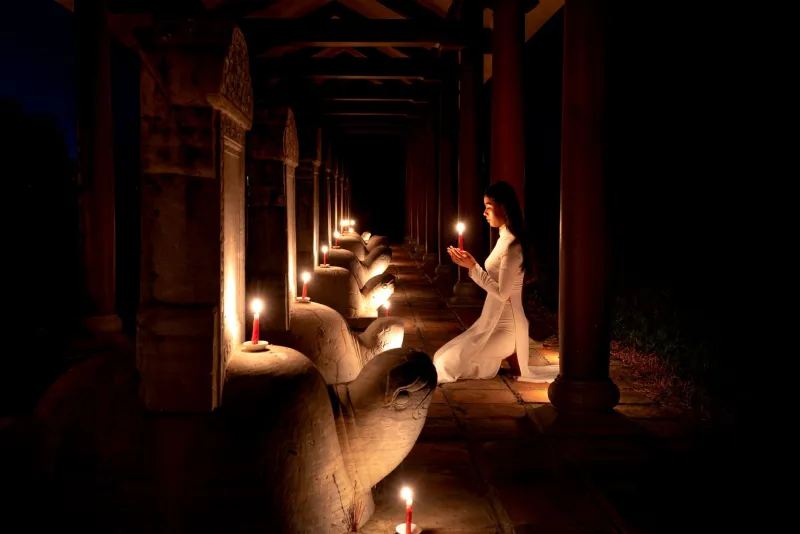
For American Anglicans navigating a cultural moment in which authenticity is simultaneously demanded and commodified — in which every spiritual experience risks becoming content — this Franciscan instinct carries unusual relevance. The body that prays, the body that weeps, the body that kneels in a cold church before dawn: these are not primarily aesthetic choices. They are acts of surrender that the Franciscan tradition has always understood as potentially transformative in ways that exceed rational comprehension.
Sensory Spirituality and the American Liturgical Renewal
Across the United States, Episcopal and Anglican parishes have in recent decades experimented with what might broadly be called sensory enrichment in worship: the recovery of incense, the expansion of gesture and movement, the use of icons, the reintroduction of extended periods of contemplative silence. These are not uniformly welcomed — they generate genuine theological debate in vestry rooms and diocesan conventions — but they represent a widespread intuition that the body has been underutilized as a participant in Anglican prayer.
The Franciscan tradition offers a coherent theological rationale for this intuition. Bonaventure's The Soul's Journey into God, one of the great systematic treatments of Franciscan mystical theology, begins not with abstract doctrine but with sense perception. The created world, encountered through the senses, is itself a ladder of ascent toward the divine. Sight, sound, touch, smell — these are not distractions from prayer but, properly ordered, the very medium through which prayer deepens.
This is remarkably consonant with the Anglican sacramental imagination, even if the two traditions arrive at the insight from different directions. Anglicanism tends to begin with liturgy and move toward the mystical. Franciscanism tends to begin with creation and the body and move toward the liturgical. The meeting point is the Eucharist — the moment in which bread and wine, matter and gesture, word and silence, converge in an act that both traditions regard as central to Christian life.
Rigor Without Reduction
One concern that thoughtful Anglicans bring to any engagement with mystical tradition is the risk of intellectual abdication — the sense that an embrace of ecstatic or embodied spirituality requires a suspension of critical judgment. This concern deserves to be taken seriously rather than dismissed.
But the Franciscan tradition, at its best, does not ask for the surrender of the intellect. It asks for the surrender of the intellect's monopoly on access to God. Duns Scotus, the great Franciscan philosopher-theologian of the thirteenth century, produced some of the most rigorous metaphysical thinking in the Western tradition — and did so in service of a spirituality that took mystical experience seriously as a source of theological knowledge. The two commitments were not in competition. They were mutually sustaining.
For American Anglicans shaped by the tradition of F.D. Maurice, William Temple, or Rowan Williams — thinkers who have consistently refused to choose between intellectual seriousness and spiritual depth — this Franciscan combination of rigor and openness to mystery should feel recognizable rather than foreign.
An Invitation to Incompleteness
Perhaps the deepest gift that Franciscan mystical theology offers to contemporary Anglican practice is not a specific technique or devotion but an orientation: a willingness to remain in the presence of what cannot be fully explained. The stigmata, whatever one makes of them historically, are a symbol of this orientation. They mark the point at which the body outpaces the theology written to describe it.
American spiritual culture tends to be uncomfortable with incompleteness. We prefer resolution, articulation, the clearly stated takeaway. Both the Franciscan and Anglican traditions, at their most mature, resist this preference. They ask their practitioners to inhabit mystery without collapsing it prematurely into certainty.
The body, it turns out, is very good at this. It knows things the mind is slow to admit. And in the space between what Francis experienced on La Verna and what an Anglican parishioner in Cincinnati or Charleston encounters at the altar rail on a Sunday morning, there may be more continuity than either tradition has yet had the courage to claim.