Choosing One: How Franciscan Commitment and Anglican Parish Belonging Unmask the Illusion of Infinite Spiritual Choice
There is a particular kind of spiritual restlessness that has come to define American religious life. It does not look like doubt, exactly. It does not present as crisis. It arrives, instead, in the form of a browser tab left open—another church's website, another tradition's podcast, another community's retreat schedule—held in reserve against the possibility that the congregation one currently attends might eventually disappoint. And it always does, of course. Every community of imperfect people eventually will.
This is the cult of endless optionality, and it has colonized not only our consumer habits but our souls. It promises that the ideal spiritual home is always one more search away. What it quietly delivers is a kind of rootlessness dressed in the language of discernment.
Against this backdrop, two ancient traditions—Franciscan and Anglican—offer something that sounds almost offensive to the modern ear: the invitation to stop looking and to stay.
The Franciscan Scandal of Staying
When Francis of Assisi gathered his earliest brothers in the hills outside of Umbria, he did not establish a mobile fellowship of like-minded seekers. He planted something. The friars were sent out, yes—into leper colonies, into marketplaces, into the margins of medieval society—but they were sent from a place, and they returned to a place. The Rule of 1223 is not merely a spiritual document; it is a geography. It assumes that formation happens in relation to specific people, in a specific landscape, over a specific and often uncomfortable duration of time.
The Franciscan commitment to particular communities was not incidental to the movement's spiritual power. It was the source of it. Francis did not love humanity in the abstract. He kissed the leper in front of him. He rebuilt the crumbling church at San Damiano stone by stone. The scandal of Franciscan spirituality is precisely its particularity—the insistence that God is encountered not in the perfect community we imagine, but in the flawed one we inhabit.
For contemporary Americans accustomed to curating their social circles with algorithmic precision, this is genuinely disorienting. The Franciscan tradition asks a question that consumer Christianity cannot process: What if the community that irritates you most is the community that is most faithfully forming you?
The Anglican Parish as Theological Argument
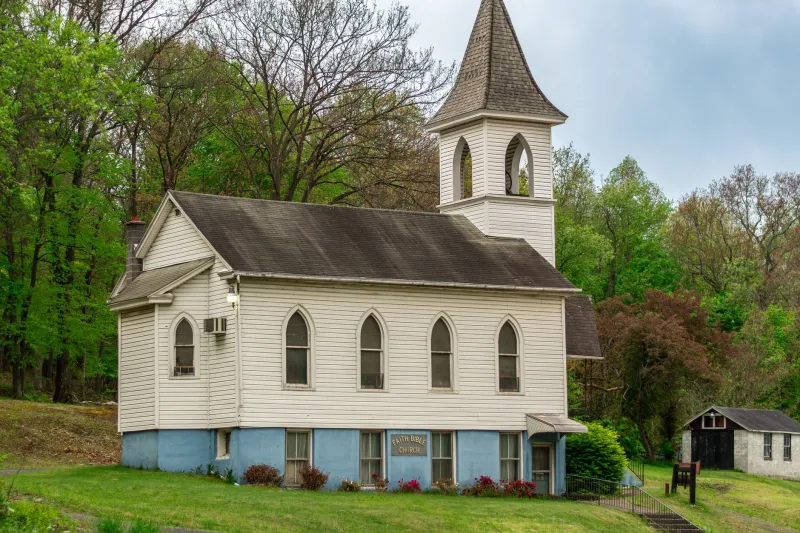
Anglicanism makes a strikingly similar argument, though it arrives by a different route. The Anglican parish system, inherited from the Church of England and adapted—imperfectly, generatively—across the American Episcopal landscape, was never designed to gather the spiritually compatible. The parish was designed to gather the geographically proximate. In its classical expression, the parish church served everyone within its bounds: the wealthy pew-holder and the laborer in the back, the devout and the barely-believing, the lifelong Anglican and the newcomer still uncertain about the creeds.
This is not merely an administrative arrangement. It is a theological statement. The Anglican parish declares, in its very structure, that the Body of Christ is not self-selected. It is given. You do not choose your neighbors in the Kingdom of God any more than you choose your biological family—and the work of learning to worship alongside people you would not have chosen is itself a form of sanctification.
The Episcopal Church in the United States has, in recent decades, struggled to hold this vision against the gravitational pull of the broader religious marketplace. Congregations have increasingly marketed themselves by demographic niche—the young professional parish, the progressive liturgical community, the family-friendly suburban church. Each of these communities may be doing genuine good. But when the parish becomes a brand, something essential is quietly surrendered.
What We Lose When We Keep Shopping
The cost of perpetual spiritual shopping is rarely named directly, because it disguises itself as wisdom. We call it "finding the right fit." We describe it as "being in a season of seeking." We invoke the language of authenticity to justify our departure from communities that have asked too much of us, or revealed too much about us.
But spiritual depth is not achieved through breadth of exposure. It is achieved through the slow, unglamorous work of remaining. The mystics understood this. The desert fathers and mothers understood this. And both the Franciscan and Anglican traditions, in their very different idioms, have preserved this understanding against considerable cultural pressure.
What is lost in the endless search is precisely what cannot be acquired quickly: the knowledge that comes from being known over time, the trust that develops only through shared difficulty, the particular grace that a community extends to a member who has stayed long enough to be genuinely seen. None of these gifts are available to the perpetual visitor.
There is also a communal cost. Communities hollowed out by chronic departure cannot sustain the depth of ministry that rooted communities can. When members treat their congregation as a provisional arrangement, leadership becomes tentative, commitment becomes conditional, and the community's capacity to take meaningful risks—to serve the poor, to welcome the stranger, to speak prophetically—is quietly eroded.
The Discipline of the Particular Yes
Both Franciscan spirituality and Anglican parish theology propose the same countercultural remedy: a particular, costly, freely chosen yes.
For the Franciscan, this yes takes the form of profession—a formal, public commitment to a community, a rule of life, and a set of relationships that one does not exit when they become inconvenient. For the Anglican parishioner, it takes the form of something less dramatic but equally demanding: the decision to stop treating one's congregation as one option among many and to begin treating it as one's actual church, with all the obligation and belonging that word implies.
This is not a counsel against discernment. There are communities that are genuinely harmful, traditions that are genuinely incompatible with one's convictions, seasons in which departure is the honest and faithful response. The Franciscan and Anglican traditions are not naive about this. But they are insistent that discernment and consumerism are not the same thing—and that a culture which has made optionality into a virtue will struggle to tell them apart.
The discipline of the particular yes costs something real. It costs the fantasy of the perfect community. It costs the comfortable distance of the perpetual seeker. It costs the self-protective posture of someone who has not yet decided to be fully present. In exchange, it offers something that no amount of spiritual browsing can provide: the slow, surprising discovery that the community you chose—with all its limitations, its difficult personalities, its imperfect liturgy—has been, all along, choosing you back.
A Prophetic Witness for This Moment
In a nation where religious affiliation continues to decline and where the communities that remain are under pressure to compete for an increasingly mobile population, the Franciscan and Anglican witness to rootedness is not merely countercultural. It is prophetic.
It announces that the Kingdom of God is not a product to be optimized. It declares that formation requires friction, that love requires duration, and that the particular community gathered in a particular place on a particular Sunday morning is not a consolation prize for those who have not yet found something better. It is, in fact, the thing itself.
To say yes to one tradition, one community, one set of difficult and beloved neighbors—this is not a failure of imagination. It is, in both the Franciscan and Anglican understandings, the beginning of wisdom.