Between the Bare Wall and the Gilded Altar: How Franciscan Simplicity and Anglican Ceremony Need Each Other
Walk into the Portiuncula—the tiny stone chapel in Assisi that Francis of Assisi restored with his own hands and regarded as the cradle of his movement—and you are struck first by what is absent. There is no elaborate reredos, no choir stalls carved from expensive wood, no accumulated weight of ecclesiastical ornament. The space speaks in the grammar of reduction. And yet it is not empty. The simplicity itself becomes a kind of fullness, a clearing in which the sacred might be more easily perceived.
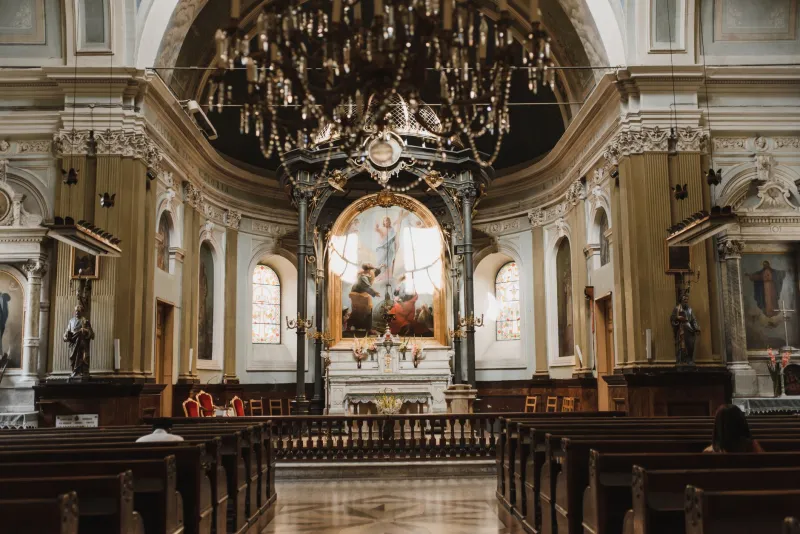
Walk, by contrast, into the Washington National Cathedral on a Sunday morning when the full liturgy is in procession—thurifer, crucifers, choir in full voice, the dense and layered language of the Book of Common Prayer rising through stone arches—and you encounter a different grammar entirely. Here, the sacred is approached not through subtraction but through accumulation, through the gathered weight of symbol and gesture and centuries of ordered praise.
These are not simply aesthetic preferences. They are theological commitments. And they are, this article will argue, more deeply intertwined than either tradition has always been willing to admit.
A History of Productive Discomfort
The relationship between Franciscan spirituality and Anglican liturgical culture has never been entirely comfortable, which is precisely what has made it generative. When Franciscan friars began arriving in England in the thirteenth century, they encountered a church already steeped in Benedictine grandeur and Norman ecclesiastical architecture. Their insistence on poverty—including poverty of worship space—was a form of implicit critique, a visible argument that the church's investment in the ornate had perhaps outpaced its investment in the poor.
The critique did not destroy the tradition it entered. It complicated it, and in complicating it, enriched it. English Christianity absorbed Franciscan sensibilities without abandoning its own liturgical instincts, producing a tradition that could hold both the mendicant friar and the cathedral canon, both the bare preaching chapel and the elaborately vested high altar, within a single ecclesial imagination.
The Reformation disrupted this equilibrium violently, stripping English churches of images and ornament in ways that Francis himself would not necessarily have endorsed—for his poverty was chosen, not imposed, and he retained a deep reverence for the beauty of the Eucharist. Anglicanism emerged from that disruption with a complex and not always resolved relationship to liturgical aesthetics, one that continues to define the tradition's internal diversity today.
What Simplicity Knows That Ceremony Can Forget
Franciscan simplicity, at its theological core, is not aestheticism. It is not minimalism as a design philosophy, and it is not the Protestant suspicion of the senses that sometimes masquerades as spiritual seriousness. It is, rather, a discipline of attention—a deliberate clearing of the visual and material field so that the eye and heart might be directed toward what cannot be possessed or adorned.
This is a gift that the Anglican liturgical tradition genuinely needs. There is a real danger in the accumulation of ceremony: the danger that the rite becomes the end rather than the means, that the beauty of the liturgy becomes an aesthetic experience rather than a transformative encounter. American Anglicanism, in particular, has sometimes allowed a certain connoisseurship of liturgy—a refined appreciation for the Rite I language, the Sarum chant, the correct color of the frontal—to substitute for the more demanding work of conversion and service.
Franciscan spirituality interrupts this tendency with a question that is at once simple and devastating: What does all of this beauty cost, and who is paying for it? The question is not an argument for iconoclasm. It is an argument for accountability—a reminder that liturgical splendor, however theologically legitimate, must be held in permanent tension with the claims of the poor.
What Ceremony Knows That Simplicity Can Forget
The debt runs in the other direction as well. Anglican liturgical richness carries a theological wisdom that Franciscan communities have sometimes been slow to acknowledge. The elaboration of ceremony—the careful choreography of gesture, the layering of text and music, the material density of vestment and incense and light—is not mere decoration. It is a theological argument about the nature of the God being worshipped.
A God who is wholly transcendent, wholly other, who exceeds every human category and confounds every human expectation, is appropriately approached with a degree of ceremony that registers that otherness. The elaborate liturgy says something that the stripped-down service cannot easily say: that this encounter matters enormously, that the One we address is not our peer, and that beauty itself—created beauty, offered back to the Creator—is a legitimate mode of praise.
Franciscan spirituality, for all its gifts, carries a temptation toward a kind of sentimental intimacy with the divine that can lose sight of this transcendence. Francis's tender address of God as Father, his fraternal relationship with all of creation, his accessibility and warmth—these are genuine spiritual treasures. But they require the counterweight of awe, of the recognition that the God who is Brother Sun is also the ground of all being, before whom the seraphim veil their faces.
Anglican ceremony, at its best, provides exactly that counterweight.
The American Context: Stripped Down or Spectacle?
Contemporary American Christianity tends to resolve this tension badly, by choosing one pole and abandoning the other entirely. The contemporary worship movement has embraced a radical informality that often owes more to consumer preference than to Franciscan theological conviction. The high-church revival, meanwhile, sometimes pursues ceremonial complexity as a form of counter-cultural identity rather than as a genuine expression of theological depth.
Neither of these resolutions is satisfying, because both abandon the productive tension that the Franciscan-Anglican encounter makes possible. What the American church needs is not a choice between the bare wall and the gilded altar, but a community that has learned to pray in both registers—that can move from the stripped simplicity of a Franciscan chapter house to the full ceremonial of a choral Eucharist and find, in both, the same God.
Toward a Theology of Both/And
The theological principle at stake here is one that both traditions share, though they approach it from different directions: the conviction that God is encountered through the material world, not despite it. Franciscan creation spirituality insists that Brother Sun and Sister Water are transparent to the divine. Anglican sacramental theology insists that bread, wine, water, and oil are genuine vehicles of grace. Both reject the Gnostic suspicion of matter that runs through so much American spirituality.
If both traditions agree that the material world is a site of divine encounter, then the question is not whether to engage the senses in worship, but how—and in what proportion, and to what end. Franciscan simplicity asks that the material be offered with open hands, without clinging. Anglican ceremony asks that it be offered with full intentionality, without carelessness.
Together, they describe a worship that is neither impoverished nor idolatrous—a worship that takes beauty seriously without making it an end in itself, that embraces simplicity without confusing it with emptiness. This is the convergence that the bare wall and the gilded altar, held together, make possible.